





More kindergarten children to learn healthy digital habits in pre-schools under IMDA programme
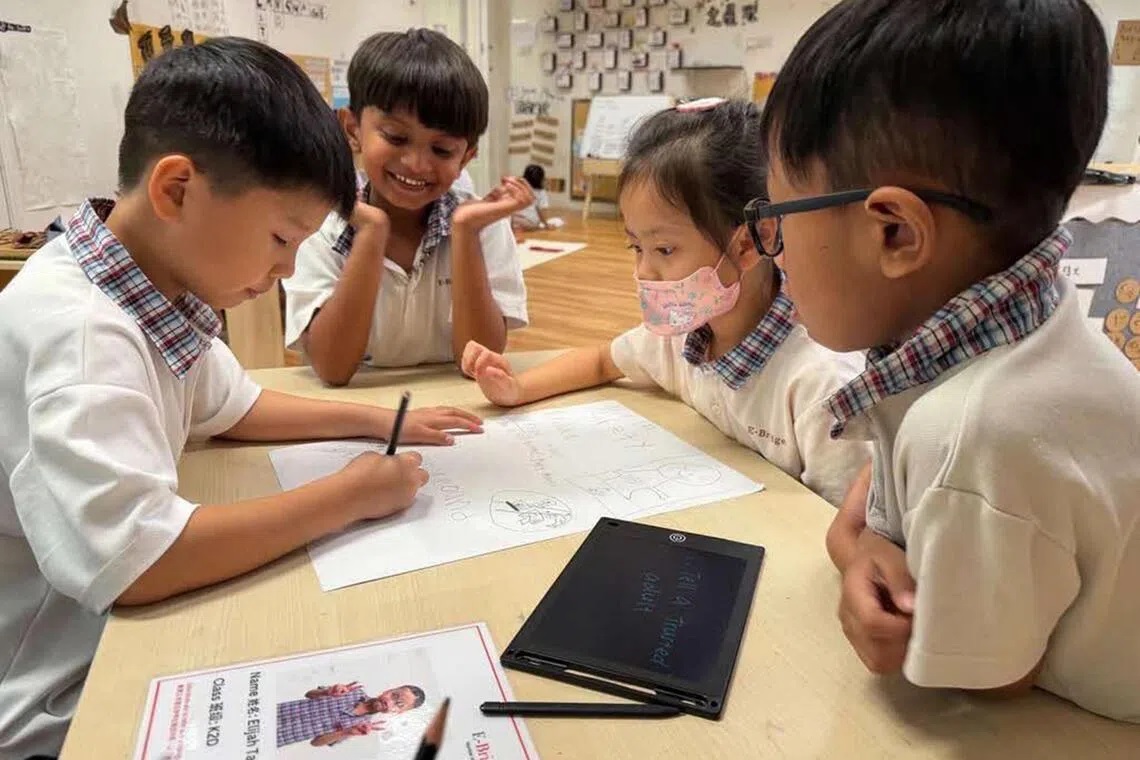
A circle of five-year-olds at a pre-school were given cartoon printouts depicting an angry man shouting, and asked a simple question: How does this picture make you feel?
Some children expressed nervousness and discomfort, while others spoke of confusion. The children were being taught to recognise the discomfort they felt when they viewed inappropriate content online, and to approach a trusted adult for help.
The cartoon printouts were shown in lieu of actual images online.
This exercise is part of a new initiative by the Infocomm Media Development Authority (IMDA) to help children learn healthy digital habits.
First piloted in April with more than 100 K2 children at E-Bridge Pre-School centres, the scheme will now be expanded to benefit more pre-school children.
Rahayu Mahzam, Minister of State for Digital Development and Information, said the IMDA plans to partner with the Early Childhood Development Agency to onboard more pre-school operators in 2027.
She made this announcement at the launch of the Digital for Life (DfL) Festival, held at VivoCity on Oct 24. President Tharman Shanmugaratnam, patron of the DfL movement, also attended the event, hosted by Minister for Digital Development and Information Josephine Teo.
Held across two weekends, the festival will offer interactive experiences for visitors to build digital skills. Next weekend’s edition will be held at Heartbeat@Bedok, from Oct 31 to Nov 1.
Skool4Kidz has already introduced the online safety lessons to 800 K2 children across 35 of its centres in September. E-Bridge will roll them out across all 30 of its centres in December, reaching nearly 3,000 K1 and K2 children.
The lessons on healthy digital habits cover four key areas – setting boundaries, thinking before acting, reporting inappropriate content, and leaning on parental support. For example, children will be taught to direct friends to get help, and engage in healthy non-screen habits like jogging and visiting the library.
Such activities for pre-schoolers are part of the broader national Screen Smart From The Start movement launched in May to help families foster healthy digital habits.
Eng Zeng Ting, centre leader at Skool4Kidz, said many of its lessons on online safety are not done on screens. They involve storytelling, role play and games.
“Limited screen time does not mean no exposure. Young children see phones and tablets around them every day… Like road safety, these habits are best learnt before children need them,” said Eng.
Alice Tay, director for learning at E-Bridge, explained that the lessons teach device usage in the same practical way teachers introduce other tools, like how to use scissors safely for crafts.
“Because digital tools are very complex, it is even more important to help them understand their purpose and safety guidelines early on,” she said.
Tay added that many parents have said they intend to give their children mobile phones at Primary 1 for safety and communication reasons. Therefore, they are glad that the school is teaching them healthy digital habits early.
Elina Er, 36, a finance manager whose K2 daughter attends the E-Bridge centre in Edgedale Plains, told The Straits Times that the classroom discussions have made their way into the family living room. These include lessons which reinforce what is taught at home, such as not using devices during mealtimes.
She said she appreciates that the children are also taught to approach an adult if they encounter content that makes them uncomfortable.
“Social media exposes children to a wide range of content, and they can stumble upon inappropriate material even when they are not actively searching for it,” she added.
The rapid rise of artificial intelligence has also found its way into pre-school chatter.
Hasmidah Abdul Hamid’s five-year-old son, who is also in K2 at E-Bridge’s Edgedale Plains centre, can now spot most AI-generated images because of what he has learnt in class.
“Even for us adults, it’s so difficult to differentiate between the real and the fake. So it’s nice that the school starts them early on this, which also gives us the opportunity to speak to the children about it at home,” said the 36-year-old pre-school educator.
She added that the school’s lessons on respecting screen time limits would help in the future, especially when the family decides to give her son his first mobile phone.
She recalls a particularly impactful lesson for her family, which involved the children coming up with an agreement on how much screen time they could have. The parents then signed off on the agreement in school.
“We don’t know how to introduce him to the concept of being online. So having the school being the one to talk about it first allows me to continue the conversations with him at home,” said Hasmidah.